Why Does Your Business Need 360 Degree Digital Marketing in 2026?
Marketing
January 19, 2026
Copy link

Dimpal Kumar
Co-Founder
Share on:
[addtoany buttons="linkedin,x,medium"]


Co-Founder
Share on:
Table of contents
Table of contents
You’re running Facebook ads. Your email team is sending newsletters. Your SEO person is publishing blog posts for AI overview. Your social media manager is posting on Instagram. Everything looks busy.
But here’s the painful truth: none of them are talking to each other. If you’re a founder or business owner, this probably sounds familiar.
The problem usually isn’t effort, budget, or talent.
👉 The real problem is fragmented marketing.
The average mid-sized business wastes $50,000 to $120,000 annually on disconnected marketing efforts.
The solution? 360 degree digital marketing-a strategy where every channel works together like a well-rehearsed orchestra, not a garage band playing different songs.
In this guide, you’ll discover exactly what 360 marketing is, why it delivers 2.8x higher ROI than traditional approaches, and how to build your own integrated 360 marketing strategy step-by-step.
360 degree digital marketing, also known as integrated marketing, is an integrated approach where all your marketing channels-social media, email, SEO, paid ads, content, and offline efforts-work together to create a seamless customer experience.
Instead of running separate campaigns that compete for attention, every touchpoint reinforces the same message and guides customers smoothly through their buying journey.
This matters because disconnected campaigns waste 40-47% of marketing budgets on duplicate efforts, conflicting messages, and lost attribution data, while integrated 360 strategies reduce customer acquisition costs by 35% and increase ROI by 2.8x.
Here’s where the 3-3-3 rule in marketing becomes crucial. While 360 degree digital marketing connects all your channels, the 3-3-3 rule keeps your strategy focused and executable. The 3-3-3 rule means concentrating on three core messages, targeting three key audience segments, and prioritizing three primary marketing channels.
This prevents the most common mistake businesses make when adopting 360 strategies—trying to do everything at once and diluting their resources.
Around 2-3 years ago, businesses could succeed with a simple approach: Run some Facebook ads, send occasional emails, maybe post on social media when you remember.
That world is gone.
Today’s customers interact with brands across an average of 9 different channels before making a purchase decision. They might discover you on Instagram, research on Google, read reviews on Reddit, sign up for your email list, see a retargeting ad, visit your website three times, and finally convert after watching a YouTube video.
If each of those touchpoints delivers a different message or contradicts the previous one, you lose them.
The most compelling evidence comes from marketing technology adoption data. Companies that invest in integrated marketing platforms-connecting their CRM, email, social, and analytics-report 3x more accurate attribution modeling.
This matters because you can’t optimize what you can’t measure. When you know which combination of touchpoints drives conversions, you stop guessing and start scaling what works.
A 360-degree digital marketing strategy works by combining all major marketing channels into one connected system so customers get a consistent experience at every stage of their journey.
Here are the 9 key components you actually need to build an effective 360-degree digital marketing plan:
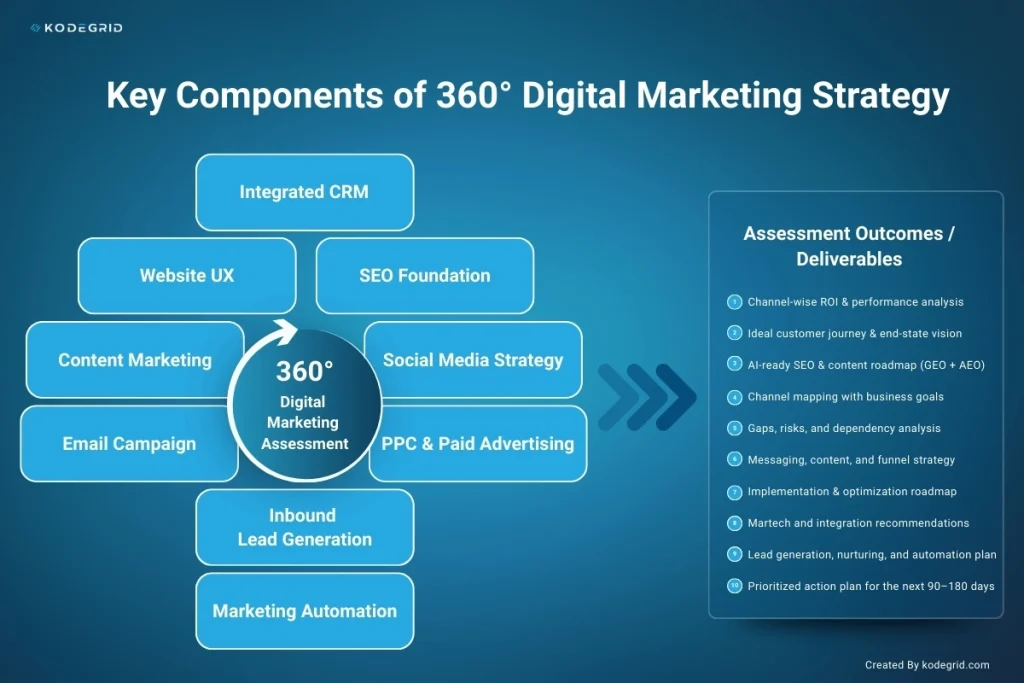
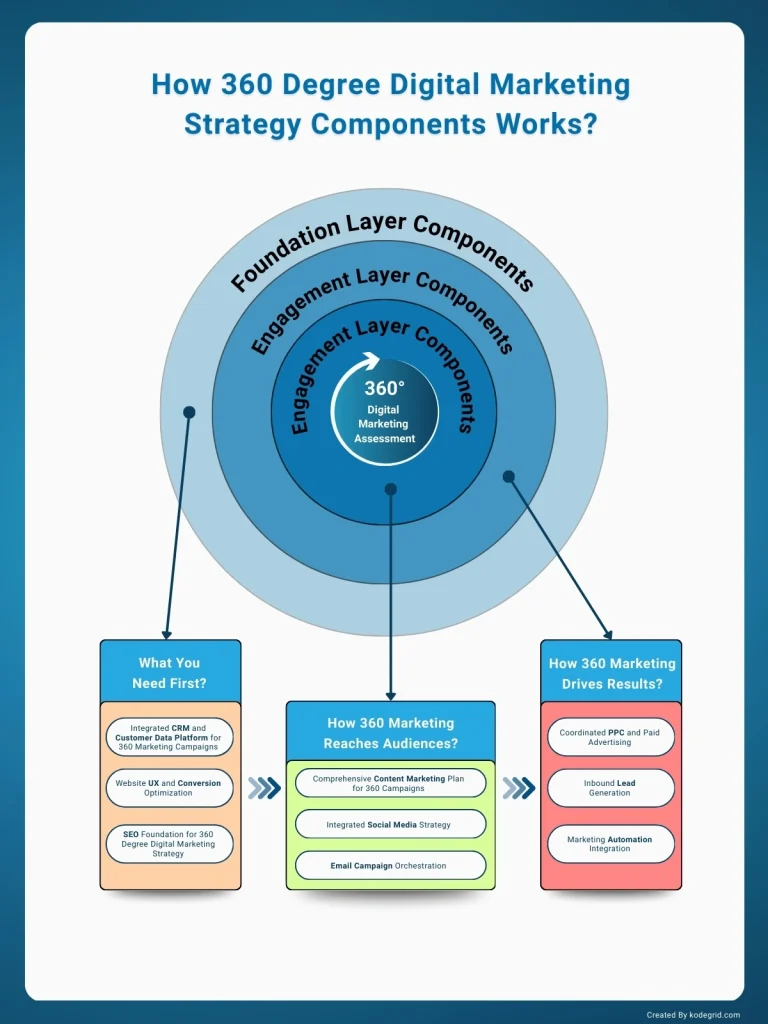
These nine 360 marketing components are organized into three layers so they work together as one integrated marketing system, connecting every touchpoint to create a smooth customer journey and drive higher conversions for the business.
Integrated CRM and Customer Data Platform for 360 Marketing Campaigns: This is your single source of truth. Every interaction-website visit, email open, ad click, purchase, support ticket-lives in one place where all your channels can access it. Without this, you’re flying blind. Popular options include HubSpot, Salesforce, or even simpler tools like ActiveCampaign for smaller businesses.
Website UX and Conversion Optimization: Your website is the hub where all channels converge. If your paid ads drive traffic to a slow, confusing website, you’re burning money. Ensure mobile-first design, fast load times (under 3 seconds), clear navigation, and conversion paths optimized for visitors coming from different channels.
SEO Foundation for 360 Degree Digital Marketing Strategy: SEO isn’t just about ranking-it’s about creating content that supports every other channel. Your paid ads can send people to SEO-optimized blog posts that educate and convert. Your email campaigns can link to guides that rank organically. Your social media can amplify content that drives organic traffic and strengthens your Local Business Appearance in search results. Build your SEO foundation around the problems your ideal customers actually search for.
Comprehensive Content Marketing Plan for 360 Campaigns: Create content once, use it everywhere-but adapted for each channel. A single customer success story becomes: a long-form blog post, a LinkedIn carousel, an email case study, video testimonials for ads, and pull quotes for social media. Your content calendar coordinates all channels, ensuring everyone amplifies the same core messages at the right times.
Integrated Social Media Strategy: Stop treating each social platform as separate kingdoms. Your social media in a 360 degree digital marketing strategy serves specific roles: LinkedIn for thought leadership and B2B relationships, Instagram for brand personality and visual storytelling, Facebook for community and retargeting, Twitter for real-time engagement and customer service. They all tell one story from different angles.
Email Campaign Orchestration: Email is your owned channel-you control it completely. In a 360 marketing plan, email doesn’t just blast promotions. It triggers based on behavior across channels (someone visited your pricing page, cart abandoned, downloaded a resource), segments based on multi-channel engagement, and personalizes based on the complete customer profile your CRM maintains.
Coordinated PPC and Paid Advertising: Your paid ads in a 360 strategy aren’t standalone-they’re amplifiers. You retarget blog readers with ads for your product. You target email subscribers who haven’t converted yet. You create lookalike audiences from customers identified through multi-channel attribution. Every ad dollar works harder because it’s informed by data from every channel.
Inbound Lead Generation: Combine content offers (ebooks, templates, webinars) with SEO, email nurture sequences, and retargeting ads. Someone downloads your guide, enters your email sequence, sees retargeting ads that address their specific challenge, and receives LinkedIn content that builds authority. That’s coordinated inbound lead generation.
Marketing Automation Integration: Connect your tools so actions in one channel trigger responses in others automatically. Someone abandons a cart? That triggers an email, updates the CRM, and starts a retargeting ad sequence. No manual work required. The systems communicate and execute your 360 marketing campaign while you focus on strategy.
Let’s get specific about what you gain when you implement an integrated 360 marketing campaign.
Companies implementing coordinated 360 degree digital marketing strategies report 25-35% lower cost per acquisition compared to siloed approaches, according to HubSpot’s 2025 State of Marketing Report.
When your channels reinforce each other, you need fewer total impressions to convert someone. Instead of a prospect seeing your ad 12 times before buying, they see your ad 4 times, read one blog post that your email linked to, and receive one perfectly timed follow-up email. Same conversion, but you spent 60% less to get there.
Consistency builds trust, and trust builds loyalty. When customers receive coherent experiences-your support team knows what marketing promised, your email campaigns build on what they learned from your content, your retargeting ads remind them of products that complement what they already bought-they stick around longer and buy more.
Think about your own behavior. You’re more loyal to brands that “remember” you, that don’t make you start from scratch every interaction, that seem to understand your needs across every touchpoint. That’s what 360 marketing creates.
Companies with integrated marketing technology stacks achieve attribution accuracy rates of 75-85%, compared to just 25-35% for businesses with disconnected systems.
Traditional “last-click” attribution is basically a lie. It says the last thing someone clicked before buying gets 100% of the credit. But what about the blog post that educated them? The email that built trust? The retargeting ad that reminded them you exist?
360 degree digital marketing implements multi-touch attribution, showing you the real customer journey. You discover that customers who engage with your content, see your ads, AND receive your emails convert at 4x the rate of those who only see ads. Now you can invest wisely instead of guessing.
Lucidpress found that consistent brand presentation across channels increases revenue by up to 23%. Humans are pattern-recognition machines. When we see consistent messages, visuals, and promises across multiple touchpoints, we conclude “this brand has their act together” and “I can trust them.” When messages conflict, we think “something’s off here” and move on to competitors.
A 360 marketing campaign ensures that the promise in your ad matches the landing page message, which aligns with your email copy, which reflects your social media content. Every touchpoint reinforces the same core value proposition.
When your marketing channels work together to educate, nurture, and build trust, prospects arrive at buying decisions faster. They don’t need five sales calls to understand your value because your content already explained it. They don’t need to “think it over” because your coordinated touchpoints already addressed their objections.
An effective 360 degree digital marketing strategy anticipates questions and objections across the customer journey, addressing them through the right channel at the right time.
If you’ve read this far, you understand why 67% of businesses waste massive budgets on disconnected campaigns while the smart 33% using 360 degree digital marketing strategies see higher ROI, 35% lower customer acquisition costs, and 28% shorter sales cycles.
The question isn’t whether you need an integrated approach-the data makes that clear. The question is: when will you start?
Three things to do First:
360 degree digital marketing isn’t about perfection-it’s about progress. Every connection you make between channels, every piece of data you unify, every message you align creates compounding returns.
The businesses winning in 2025 aren’t the ones with the biggest budgets. They’re the ones whose budgets work together instead of against each other.
Let’s bring this full circle to where we started.
Remember that painful scenario from the introduction? Your Facebook ads promising one thing, your emails saying another, your website showing a third message—and customers choosing your competitor because they’re confused?
That’s not just a messaging problem. It’s a revenue problem.
360-Degree Digital Marketing Isn’t About Doing More It’s about connecting what you already do. You already have an email. You already have a website. You already run ads or post on social media or create content. The infrastructure exists. The channels are running. The team is in place.
What’s missing is integration. Coordination. A unified strategy where every piece knows what the other pieces are doing.
When you build those connections: You grow faster. Not because you’re doing more, but because every dollar, every hour, and every piece of content works 2-3x harder.
Ready to implement 360 degree digital marketing in your business?
Let’s connect and discuss the problems you’re facing without a 360 degree strategy. We’ll audit your entire marketing ecosystem and provide you with clear action steps you can take in 2026 to grow faster, spend smarter, and finally make all your channels work together instead of against each other.