Why Are Businesses Moving to Web3 eCommerce Website Development in 2026 ?
Blockchain
May 19, 2026
Copy link

Kodegrid Team
Co-Founder
Share on:
[addtoany buttons="linkedin,x,medium"]

Co-Founder
Share on:
Table of contents
Table of contents
You built your online store. You’re paying Stripe 2.9% on every sale. PayPal holds your funds for 21 days after a dispute. Your customer data sits on Shopify’s servers – not yours. And if the platform changes its rules tomorrow, your business changes with it.
This is the reality of Web2 eCommerce in 2026.
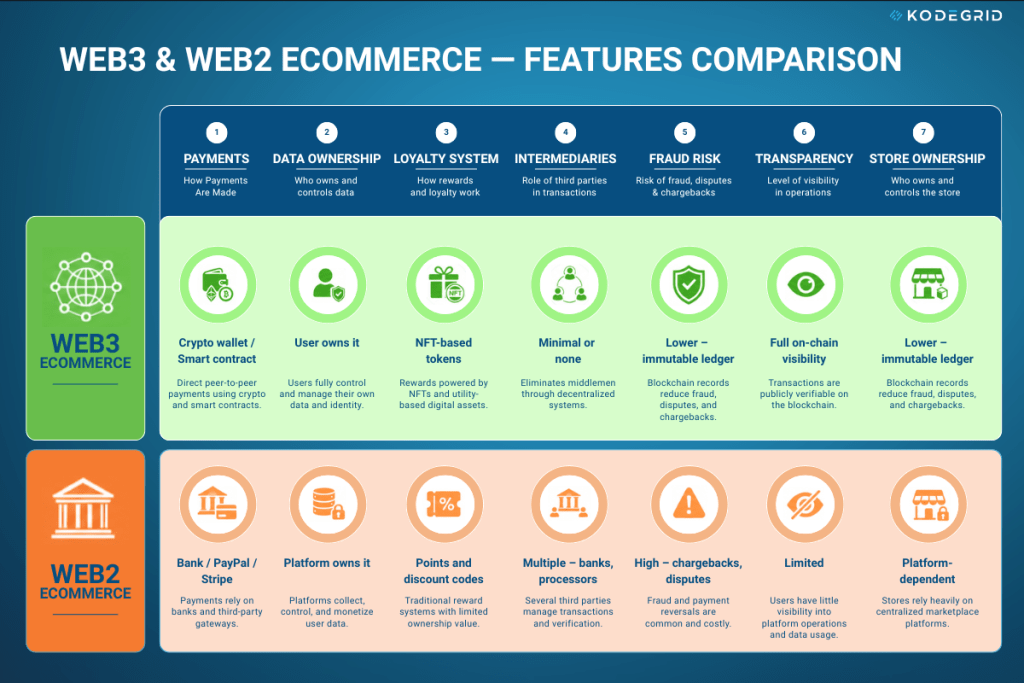
Web3 eCommerce website development changes that equation. Instead of card details and bank approvals, customers connect a crypto wallet and complete purchases through smart contracts. Instead of platform-controlled loyalty points, they earn NFT-based tokens they actually own. Instead of centralised data, ownership shifts back to users.
Traditional eCommerce changed how people shop. Web3 is changing who owns the experience.
For startups, retailers, and digital-first companies, Web3 shopping website development is no longer a trend – it is a practical business infrastructure choice with real financial consequences for building direct customer relationships and creating new digital ownership models.
This guide breaks down exactly how it works, what it costs, and how to build one – in plain language, no crypto jargon required.
Web3 eCommerce website development is the process of building online stores on blockchain infrastructure – where payments run through smart contracts, customers use crypto wallets instead of saved card details, and ownership of data, assets, and loyalty rewards shifts from platforms to users.
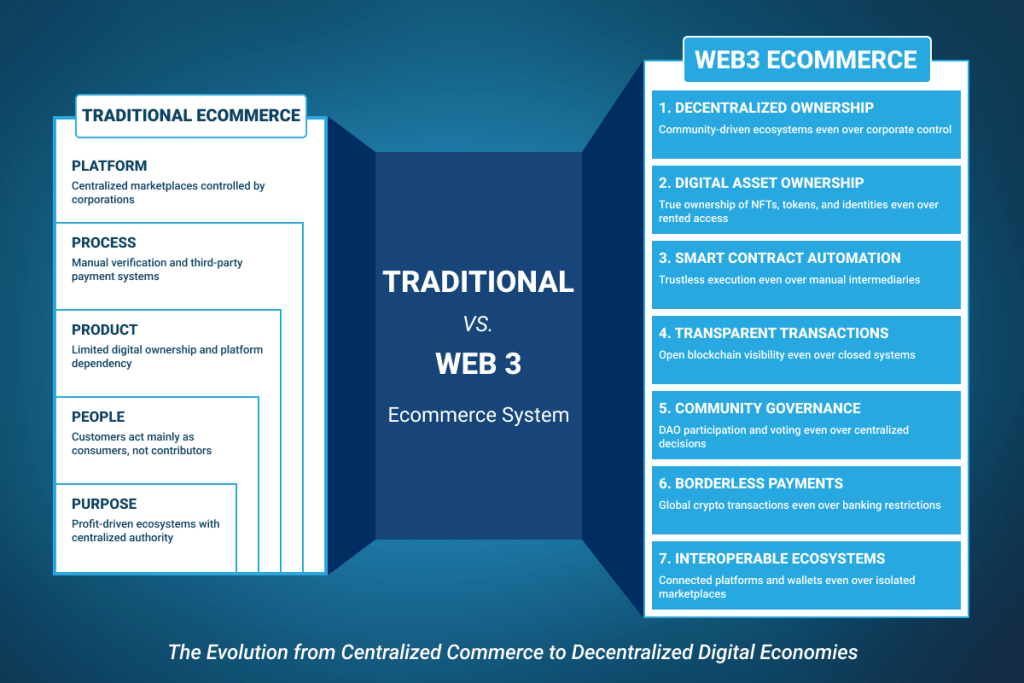
Unlike traditional eCommerce, a Web3 platform does not rely on centralized payment processors, third-party servers, or platform-controlled rules. Transactions are automated, transparent, and recorded permanently on a blockchain using cryptographic hashing mechanisms that make blockchain systems tamper-resistant and secure.
For example, instead of customers logging in with email and passwords, they can connect crypto wallets like MetaMask. Instead of traditional loyalty points, businesses can offer NFTs or token-based rewards. Instead of relying entirely on third-party payment processors, transactions can happen directly on blockchain networks.
That is why blockchain and eCommerce are becoming closely connected in 2026.
The global blockchain in retail market is projected to cross $25.8 Billion by 2029, driven by decentralized commerce infrastructure, not speculation. Through effective Web3 and e-commerce integration, businesses can leverage blockchain technology to create more transparent, secure, and customer-centric decentralized ecommerce marketplace experiences.
Web3 platforms cut fraud by 75% via immutable ledgers and if you’re thinking, “Is blockchain technology for ecommerce worth it?”
Yes-for loyalty via token rewards that boost retention 35%.
This isn’t generic advice; it’s tailored for founders like you, eyeing web3 shopping website development to outpace competitors stuck in Web2.
Here is what is actually driving that number:
Stripe and PayPal charge between 2.5% and 3% per transaction. For a store doing $1 million in annual revenue, that is $25,000–$30,000 in fees every year – gone. Smart contracts settle payments directly between buyer and seller with near-zero fees. That margin goes back to the business.
Traditional loyalty programs give customers points that expire, have no real value, and disappear if the brand shuts down. NFT-based loyalty tokens are assets customers actually own – tradeable, transferable, and tied to real brand value. Retention rates on ownership-based loyalty consistently outperform traditional points programs.
Over 500 million people globally hold cryptocurrency. These buyers actively prefer on-chain commerce. A Web3 storefront opens your business to a segment that most Web2 stores cannot serve at all.
2025 and 2026 have brought clearer crypto commerce guidelines across the US, EU, and major Asian markets. The legal uncertainty that once slowed Web3 adoption is largely resolved for standard commerce use cases.
Most people assume Web3 eCommerce is just “accepting crypto.” It’s much deeper than that.
Web3 eCommerce platform development goes beyond adding a ‘pay with crypto’ button. A full platform includes:
This is what separates a Web3 eCommerce platform from a Web2 store that merely accepts cryptocurrency. The platform architecture is what enables decentralised eCommerce marketplace development at scale.
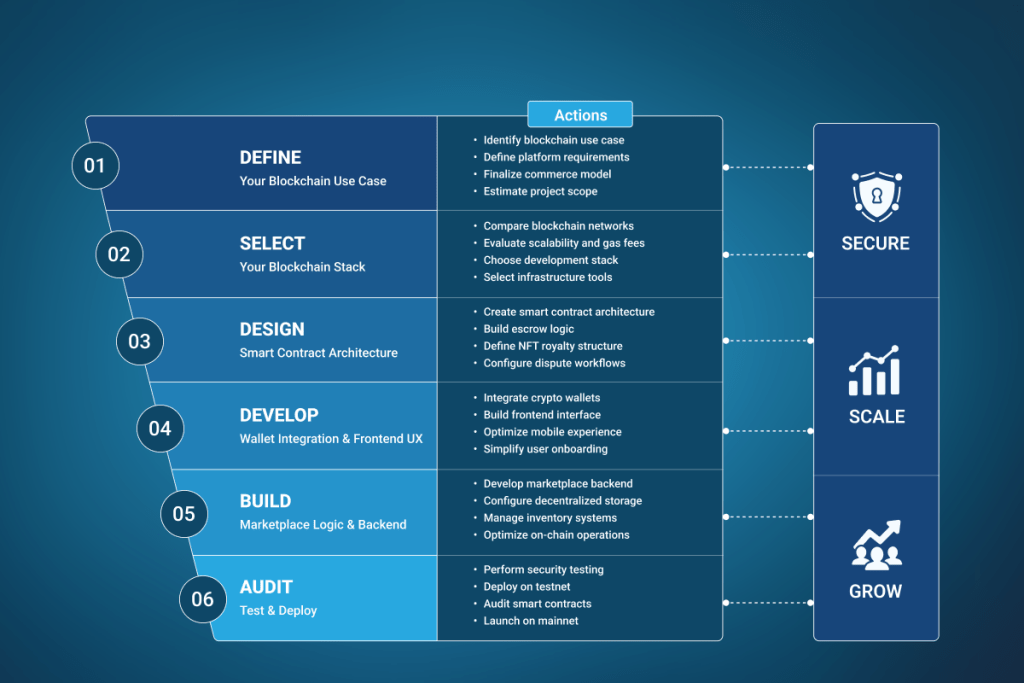
Before writing a single line of code, answer this question: What problem are you actually solving with blockchain?
This decision determines your entire tech stack and your budget. Most Web3 projects go over budget because this step gets skipped.
Not all blockchains are equal for eCommerce. Here is a practical breakdown:
For most businesses building their first Web3 eCommerce platform, Polygon is the practical starting point.
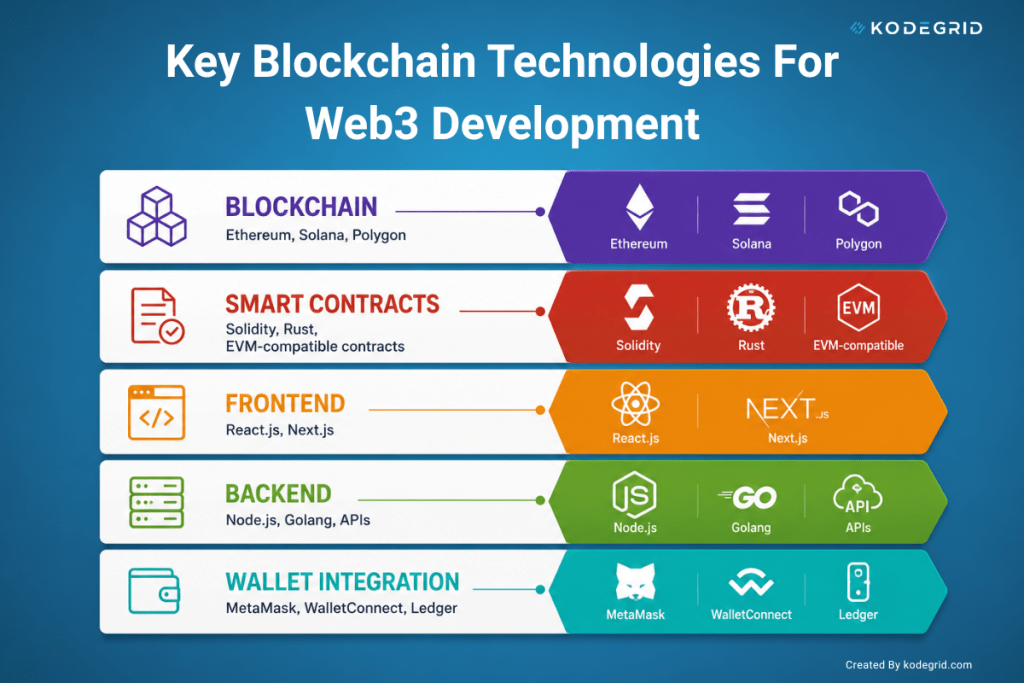
This is where most Web3 projects fail without experienced development partners.
Your smart contracts handle:
The architecture decisions made here affect security, gas costs, and scalability for the entire life of the platform. Getting this wrong is not a bug you patch – it is a vulnerability that can drain your store’s funds.
The biggest UX challenge in Web3 eCommerce is that most buyers are not crypto-native. Your store needs to work for both audiences.
For crypto users: MetaMask, WalletConnect, Coinbase Wallet integration
For non-crypto users: Embedded wallets – tools like Privy and Dynamic let users sign in with their email and receive a wallet silently, with no seed phrases or crypto knowledge required
Frontend tech stack: React with ethers.js or Web3.js, built mobile-first. A Web3 store that does not work on mobile in 2026 is already behind.
This is the layer most people do not think about when they picture Web3 – but it is where the experience lives.
This step is not optional. It is the step that separates functional Web3 stores from exploited ones.
Testnet first: Deploy on Sepolia (Ethereum) or Mumbai (Polygon) and run full functional testing before touching mainnet.
Smart contract audit: A third-party audit reviews your contracts for reentrancy attacks, integer overflow vulnerabilities, and access control gaps. Skipping this step has cost Web3 projects millions of dollars in exploits.
Then deploy to mainnet – and continue monitoring post-launch.
As adoption of Web3 in e-commerce & retail market continues to grow, more businesses are exploring blockchain ecommerce marketplace development. While the opportunities are significant, building a Web3 eCommerce platform comes with its own set of technical and operational challenges.
Understanding these challenges early can help businesses plan better, reduce risks, and create a seamless experience for both customers and merchants.
Problem: Transaction costs on Ethereum mainnet spike unpredictably.
Solution: Build on Layer-2 networks – Polygon, Arbitrum, or Base – where fees consistently stay under $0.01 per transaction.
Problem: Most buyers do not know what MetaMask is, let alone how to use it.
Solution: Embedded wallets (Privy, Dynamic) let users log in with email and interact with your Web3 store without ever knowing they have a wallet. This is the bridge between Web3 infrastructure and Web2 user behavior.
Problem: A single bug in a smart contract can drain your entire store’s funds. There is no “undo” on a blockchain.
Solution: Mandatory third-party audit before mainnet deployment, plus post-launch monitoring. No exceptions.
Problem: Crypto commerce laws still vary by jurisdiction, especially for token-based loyalty and DAO governance.
Solution: Jurisdiction-aware contract design and legal review before launch. This is especially important in the EU and US for anything that could be classified as a security.
Problem: On-chain transactions bottleneck during flash sales.
Solution: Hybrid architecture – critical transactions on-chain, high-frequency browsing and search actions off-chain with periodic settlement.
Web3 shopping website development is not a future trend to watch – it is a present infrastructure choice with real financial consequences.
Businesses that move now are cutting payment processor fees, building customer loyalty that actually retains, and accessing a 500-million-strong buyer segment that Web2 stores cannot reach. Businesses that wait are watching that window get smaller every quarter.
Whether you are building a blockchain-based eCommerce platform from scratch, layering crypto payments onto an existing store, or developing a full decentralized marketplace – the technical foundation you build in the first 30 days shapes everything that follows.
Kodegrid works with businesses at every stage of Web3 eCommerce development – from initial blockchain consulting and smart contract architecture to full dApp builds and pre-launch audits. If you are mapping out a Web3 commerce project, explore Kodegrid’s Web3 development services or speak with our blockchain consultant to scope your build the right way from day one.