#9 Challenges In Creating Crypto Exchange That Costs You $1M+
Blockchain
February 13, 2026
Copy link

Dimpal Kumar
Co-Founder




Co-Founder
Table of contents
Table of contents
You’ve secured $500,000 in funding. Your dev team promises a crypto exchange launch in 6 months. The market looks hot. Your pitch deck projects profitability by month 8.
Launching a crypto exchange seems simple from the outside.
You buy a ready-made script.
You integrate basic wallets.
You list a handful of tokens.
You fire up marketing campaigns.
Fast forward 14 months: Your exchange is offline. Regulators issue a cease-and-desist. Your liquidity provider ghosts you. Legal bills alone hit $200,000.
This isn’t hypothetical-it’s reality for 73% of new crypto exchange founders who underestimate what it truly takes in 2026.
The crypto exchange market remains lucrative-$50 trillion in annual trading volume with 500 million global users. But the gap between “building an exchange” and “building a successful exchange” has never been wider. New regulations like MiCA in Europe, security threats causing $1.7B in losses last year, and liquidity requirements starting at $5M+ have transformed this from a simple tech challenge into a comprehensive business operation.
This guide breaks down the 9 critical challenges in creating a crypto exchange that separate the 27% of successful platforms from the 73% that fail. Unlike outdated 2024 pitfalls, we’re covering 2026 realities with current regulatory updates, real cost breakdowns, and actionable insights from recent exchange launches.
Let’s organize and explain all these crypto exchange building challenges into 4 clear phases, so you can understand exactly where you might be stuck – and what needs to be fixed.
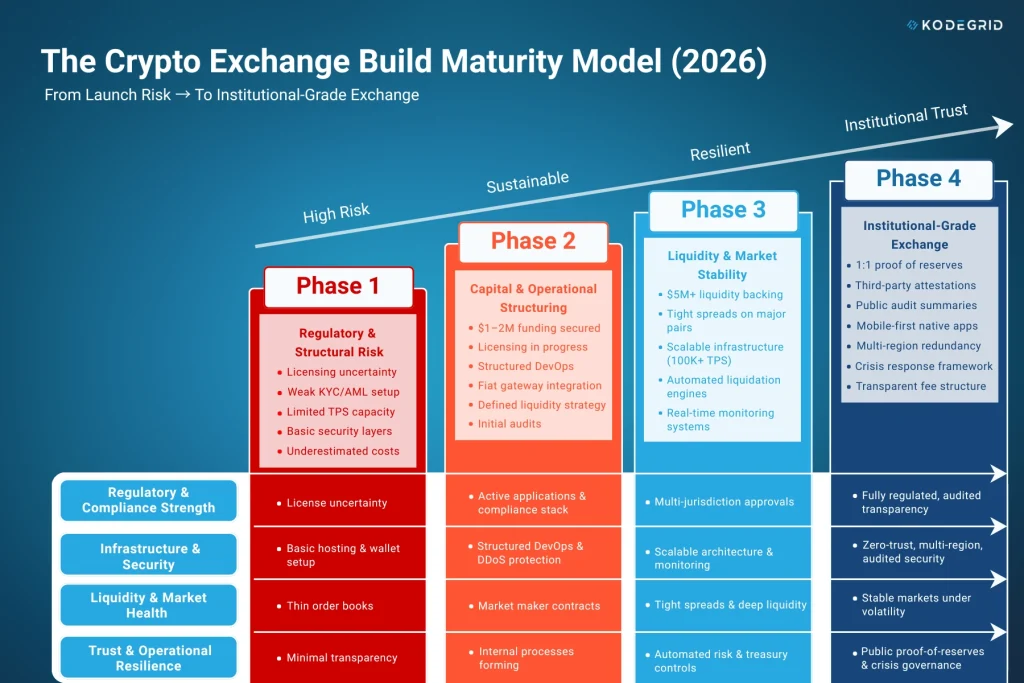
“Obtaining licenses in 3+ jurisdictions now takes 8-14 months on average and costs $300K-500K, with rejection rates exceeding 40% for first-time applicants.”
This is the challenge most founders underestimate – and the one that can shut your exchange down overnight. Regulatory compliance isn’t just paperwork-it’s the difference between operating legally and receiving shutdown notices that freeze all user funds overnight.
In 2026, the regulatory landscape has matured significantly, and “launch first, ask permission later” is effectively dead. Different regions now have clear frameworks, and each comes with capital, licensing, and operational requirements.
Europe (MiCA Framework):
Since January 2025, exchanges serving EU customers must obtain CASP authorization under MiCA. This requires capital reserves, custody controls, and strict compliance reporting. Approval grants access to all 27 EU countries.

United States (State-Level Licensing):
The U.S. requires state-by-state Money Transmitter Licenses, plus compliance with FinCEN, SEC, and CFTC rules depending on services. This creates high legal complexity and cost.
KYC/AML Infrastructure:
Modern crypto exchanges must implement strong identity verification systems, transaction monitoring tools, sanctions screening, and suspicious activity reporting. These are not simple integrations – they require continuous compliance management and operational oversight.
Emerging Crypto-Friendly Jurisdictions:
The UAE (VARA), Singapore (MAS), and Hong Kong (VASP regime) offer clearer regulatory frameworks, but still require capital, reporting, and structured compliance.
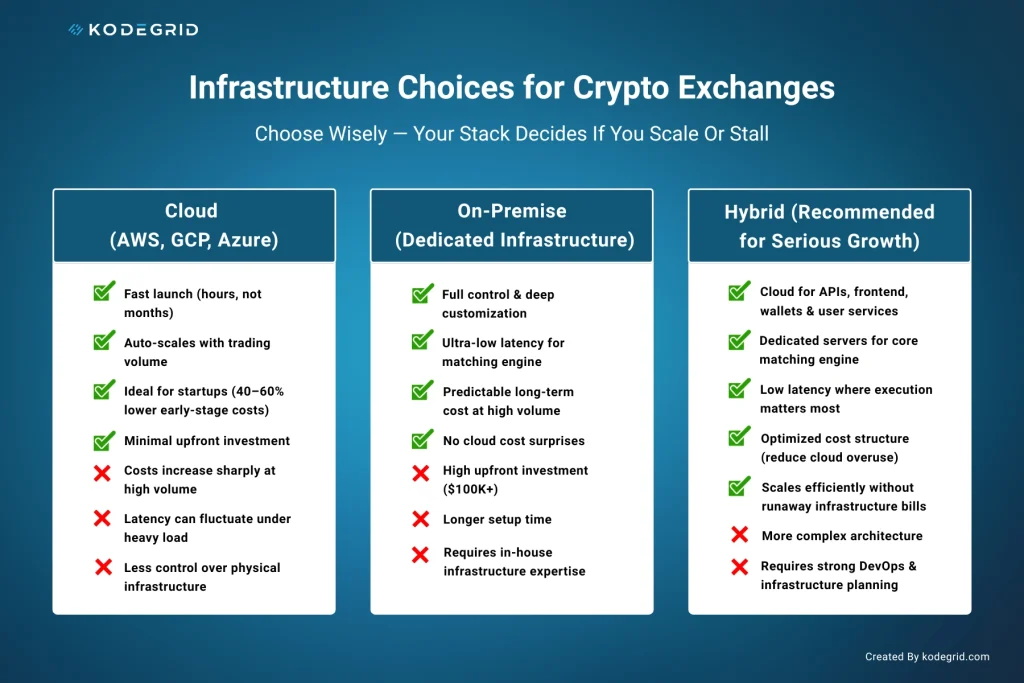
“Exchanges processing under 100,000 transactions per second can’t compete with established players. Yet 70% of new platforms launch with infrastructure that can’t scale beyond 10,000 TPS.”
Many founders launch with a working product. Very few launch with a scalable system.
There’s a difference.
A scalable cryptocurrency exchange must handle sudden traffic spikes without slowing down or crashing.
Technical scalability isn’t about handling today’s load-it’s about surviving tomorrow’s success. Launch with 1,000 users and handle it fine. Get featured on TechCrunch and 50,000 users flood in simultaneously. Can your servers handle it, or does everything crash right when you need to make a perfect first impression?
Most exchanges don’t fail because of marketing. They fail because their system collapses when traffic increases.
“Crypto exchanges suffered $1.7B in losses in 2025, with 68% from infrastructure vulnerabilities. The average breach costs $8M and destroys user trust permanently.”
Crypto exchanges are among the most targeted digital platforms in the world.
You are not just storing user data.
You are storing digital assets.
Security isn’t about preventing every attack-that’s impossible. It’s about making your exchange so expensive and difficult to breach that attackers move to easier targets. Think of it like home security: you don’t need an unbreakable fortress, just better protection than your neighbors.
The Security Layers That Raise the Cost of Attack
“The average crypto exchange requires $1-2M in initial capital, with 40% allocated to regulatory compliance alone-yet 68% of founders under budget by 50% or more.”
This is where many exchanges quietly fail – not publicly, but financially.
At the beginning, the math looks simple.
Founders often calculate: “Script cost + developer cost = launch.”
That assumption is where reality starts pushing back. Because launching an exchange isn’t buying software – it’s committing to an ongoing operational machine.
But real costs include:
And here’s the biggest oversight:
It can take 12 to 24 months before an exchange becomes meaningfully profitable.
During that period, you still need a budget for web3 marketing to acquire users. You need capital ready for infrastructure scaling when volume spikes. You need reserves for unexpected regulatory changes. And you need enough financial cushion to survive market downturns – because crypto cycles are not gentle.
If you don’t have a runway, growth won’t save you. It will strain you.
“Development is just the entry ticket. Operations are a long game.”
“Exchanges without fiat on-ramps lose 80% of non-crypto-native users. Yet payment processor costs and compliance add 3-5% to every transaction, cutting into margins significantly.”
Fiat integration is the bridge between traditional finance and crypto-and it’s one of the most challenging aspects of exchange operation. Banks don’t want to work with crypto companies, payment processors charge premium fees, and chargebacks create constant headaches.
The vast majority of potential crypto users don’t already hold cryptocurrency. If your exchange only accepts crypto deposits, you’ve immediately excluded 80%+ of your addressable market. Users need to buy crypto somewhere else, figure out wallet addresses, transfer it to your exchange-massive friction that kills conversion.
Most common challenges include:
“New exchanges need $5M+ in guaranteed liquidity to attract serious traders. Liquidity challenges cause 40% of all crypto exchange failures-making this the #1 killer of new platforms.”
Liquidity is the lifeblood of any exchange, yet it’s the challenge founders understand least. You can have perfect technology, full regulatory compliance, and military-grade security-but without liquidity, you have an empty marketplace where no one wants to trade.
Why liquidity kills exchanges-the death spiral?
Imagine you want to buy Bitcoin. On Binance, you can buy $100,000 worth at $65,000 per BTC. On a new exchange, the same $100,000 order gets filled between $65,000 and $65,300 because there’s not enough sell orders at $65,000. That $300 difference is slippage-you paid more than market price.
Traders won’t tolerate >2% spreads on major pairs. If Bitcoin trades at $65,000, professional traders expect to buy at $65,050 or less and sell at $64,950 or more. Wider spreads mean they lose money on every trade, so they leave immediately. This creates a death spiral that causes traders to lose money on the platform.
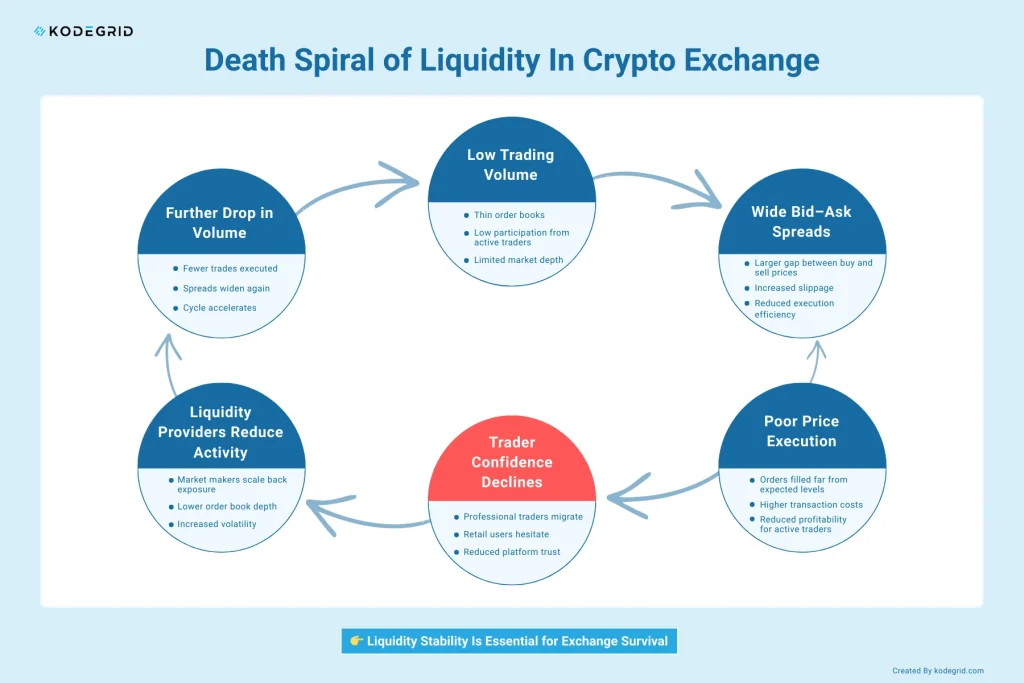
Breaking this cycle requires massive capital injection before the spiral starts. Even if your user interface is polished and your security architecture is airtight, your exchange will struggle to retain traders if liquidity is weak.
In trading environments, appearance and features create first impressions – but liquidity determines long-term survival and strong liquidity requires deliberate planning and structured partnerships.
“78% of crypto traders now use mobile as their primary trading device, yet 65% of new exchanges launch with desktop-first experiences. Poor UX causes 30% user churn within the first week.”
User experience is where many technically sound exchanges fail. You can have blazing-fast infrastructure and perfect security, but if users can’t figure out how to buy Bitcoin in under 5 minutes, they’ll switch to Coinbase and never come back.
In 2026, mobile isn’t a backup plan – it’s the main way people trade. This is especially true in emerging markets, where many users don’t even own a desktop computer. For most traders, their phone is their trading desk.
That means your mobile experience can’t just be a basic website squeezed into an app. It needs to be real, native apps built specifically for iOS and Android – designed for touch, speed, and simplicity.
Native apps can use important phone features like fingerprint or Face ID login, instant push notifications for price alerts, and the camera for uploading KYC documents. They load faster, feel smoother, and can even let users view certain account information offline.
If mobile isn’t excellent, users won’t stick around. It’s that simple.
“Market volatility events cause 250% spikes in customer support tickets and 500% increases in system load. Exchanges without robust operational plans lose $100K+ per hour during outages.”
Operational risk management is everything that can go wrong outside of technical bugs and security breaches. It’s market crashes causing panic, regulatory inquiries demanding immediate responses, PR crises from competitors spreading rumors, and the hundred other fires that burn simultaneously while you’re trying to run a business.
Most founders focus on building the exchange. Very few prepare for when things go wrong.
Operational risk management is about surviving extreme moments. Here are some common risks:
Operational risk management often goes unnoticed when markets are calm. But during extreme volatility, it becomes the line between being seen as a trusted exchange or becoming a public disaster.
“89% of traders check an exchange’s proof of reserves before depositing significant funds. Yet only 12% of new exchanges implement transparent reserve verification from day one.”
Trust is your most valuable asset and most fragile liability. Build it slowly over years, lose it instantly with one mistake. In 2026, after FTX’s spectacular collapse cost users $8 billion, traders demand transparency mechanisms that were optional extras in earlier years.
Trust requires verifiable proof. Exchanges must provide proof of reserves, maintain a 1:1 reserve ratio, and publish third-party attestations confirming assets exceed liabilities. Real-time reserve dashboards and on-chain wallet verification are increasingly expected.
Transparency must extend to fees, trading volume verification, insurance funds, and regular audit reports. Public smart contract audits, penetration testing summaries, and recognized compliance certifications strengthen credibility.
Clear company registration, disclosed leadership, published licenses, and defined incident response policies demonstrate accountability.
In modern markets, measurable transparency – not marketing – determines long-term survival.
Yes – but only under the right conditions.
Launching a crypto exchange in 2026 is achievable – but only with realistic capital, patience, and discipline. The 73% failure rate reflects underfunding, weak liquidity, poor compliance, and inadequate security.
At minimum, expect $2M+ in funding, 18–24 months to reach stability, and significant liquidity to create functional markets. Regulatory compliance and strong security are not optional – they determine survival. Most successful launches also focus on a clear niche rather than competing broadly.
If you meet these requirements and execute methodically, your odds improve. If not, alternative models are far safer than rushing into an undercapitalized launch.


