How To Scale a Cryptocurrency Exchange Business In 2026 : A Founder’s Practical Guide
Blockchain
February 11, 2026
Copy link

Dimpal Kumar
Co-Founder
Share on:
[addtoany buttons="linkedin,x,medium"]

Co-Founder
Share on:
Table of contents
Table of contents
You’ve built your cryptocurrency exchange. The technology works. Your first hundred users are trading smoothly.
Then you ask yourself the question that keeps every exchange founder awake at night:
“What happens when 10,000 users try to trade at the same time?”
Here’s the uncomfortable truth: 67% of cryptocurrency exchanges fail within their first 18 months. And here’s what might surprise you-most don’t fail because of poor marketing or lack of users. They fail because their infrastructure collapses the moment real growth hits.
Picture this: Bitcoin surges 15% in an hour. Your users rush to trade. Your servers crash. Orders freeze. Frustrated traders move to competitors. Within 48 hours, you’ve lost 30% of your user base-and they’re not coming back.
This doesn’t have to be your story.
This guide shows you exactly how successful exchanges scale from handling 1,000 daily users to 100,000+ without downtime, security breaches, or complete re-engineering. Whether you’re planning your first exchange or struggling to scale an existing platform, you’ll learn the proven framework that separates exchanges that thrive from those that become cautionary tales.
Let’s start with the most important question.
When most founders think about scalability, they imagine handling more users. That’s only half the picture.
True scalability for a crypto exchange means your platform maintains performance, security, and reliability even when traffic increases 10x overnight – despite all the challenges in creating a crypto exchange you’ll face along the way.
Think about what happens during market volatility. Bitcoin announces a major upgrade. Ethereum’s price jumps 20%. Suddenly, everyone wants to trade at once. A scalable exchange handles this surge seamlessly. A non-scalable exchange crashes, costing you users, revenue, and reputation.
Transactions Per Second (TPS): How many orders can your matching engine process simultaneously?
Order Execution Time: How quickly does your system match buy and sell orders?
Concurrent User Capacity: How many people can use your platform simultaneously?
API Response Time: How quickly your API replies to requests from bots and institutional traders?
There’s a crucial difference between vertical scaling and horizontal scaling. Vertical scaling means buying bigger, more powerful servers-think upgrading from a Honda to a Ferrari. Horizontal scaling means adding more servers to distribute the workload-like having a fleet of vehicles instead of one supercar.
Here’s the reality: vertical scaling has limits. You can only make one server so powerful. Horizontal scaling is how major exchanges handle millions of users.
A truly scalable crypto exchange maintains sub-50 millisecond API response times, executes orders in under 100 milliseconds, and keeps trading available 99.95% of the time-that’s less than 4 hours of downtime per year, even when processing 10 times normal traffic.
You’ve optimized your code. Your database queries are efficient. Everything runs smoothly with 500 concurrent users.
Then Bitcoin spikes 10% in thirty minutes.
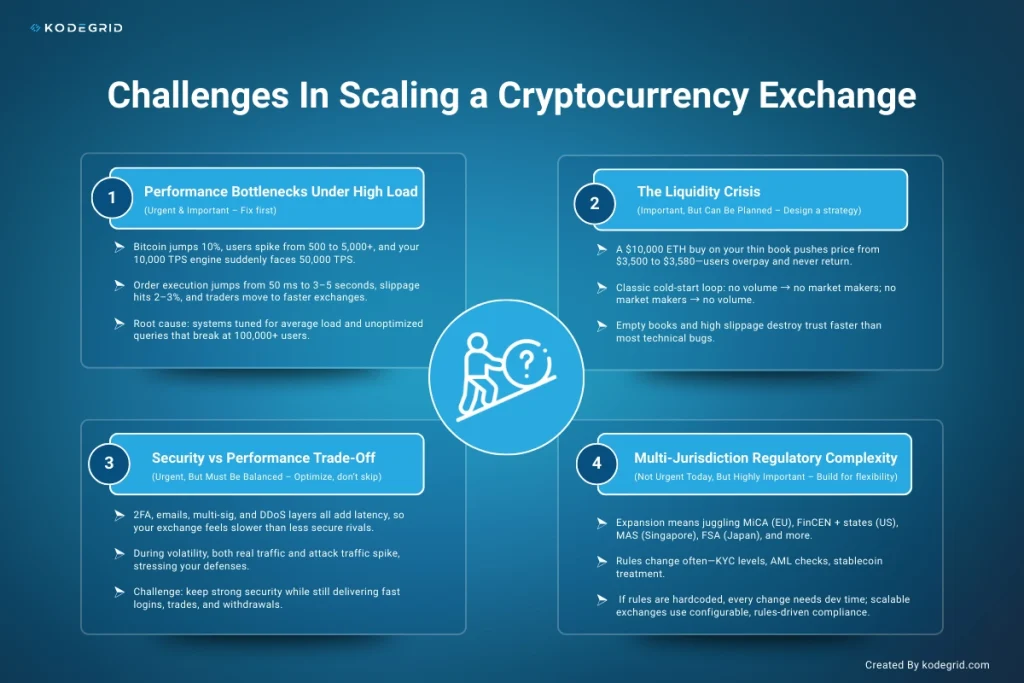
Suddenly, 5,000 users are trying to trade simultaneously. Your trading engine, designed to handle 10,000 orders per second, gets hammered with 50,000. Order execution time jumps from 50 milliseconds to 3-5 seconds. Users see delayed confirmations. Market prices move before their trades execute. They experience slippage-buying at prices 2-3% higher than they expected.
Within an hour, you’ve lost their trust. Within a day, they moved to a faster exchange.
The root cause? Most exchanges optimize for average load, not peak load. But in crypto, peak load is what matters. Markets don’t crash between 9 AM and 5 PM on weekdays. They crash at 2 AM on Sunday when you’re asleep.
Database query optimization becomes critical at scale. That query returning user balances in 10 milliseconds at 1,000 users? It takes 2 seconds at 100,000 users if you haven’t implemented proper indexing and caching.
Here’s a scenario that kills exchanges faster than any technical issue:
A user wants to buy $10,000 worth of Ethereum. On Exchange A, they get it at $3,500 per ETH-current market price. On Exchange B (yours), the order book is thin. Their $10,000 order pushes the price to $3,580 per ETH. They’ve just paid $800 more for the same trade.
They never come back.
This is the cold-start problem: you need trading volume to attract market makers, but you need market makers to build trading volume. It’s the chicken-and-egg dilemma that has killed 78% of failed exchanges, according to post-mortem analyses.
Empty order books and high slippage destroy user trust faster than any technical glitch. Because even if your technology is perfect, traders can’t use an exchange where they lose money on every trade due to poor liquidity.
Every security measure you add slows down your system. security of centralized exchanges
Two-factor authentication? Adds 200-500 milliseconds per login. Withdrawal verification emails? Another 1-2 seconds delay. Multi-signature wallet approvals? Can take 30-60 seconds. DDoS protection layers? Each one adds 20-40 milliseconds of latency.
You can’t eliminate these security measures. But here’s the challenge: your competitors might be cutting corners on security to offer faster trades. Users often don’t understand the trade-off. They just know your exchange “feels slower.”
Meanwhile, DDoS attacks increase 10x during high-volatility periods. Hackers know that when Bitcoin surges, exchanges are overwhelmed with legitimate traffic-the perfect time to launch an attack that your systems might not distinguish from normal load.
You launch in one country with clear regulations. Growth is happening. Now you want to expand to three more countries.
Suddenly you’re dealing with:
Compliance requirements vary across 195+ jurisdictions, and they change constantly. South Korea announces new KYC rules. The EU updates its anti-money laundering directives. The US proposes new stablecoin regulations.
If your compliance system is hardcoded-if every rule is buried in your application code-you’ll need developer time for every regulatory change. At scale, you might be updating compliance rules weekly. That’s not sustainable.
If you’re still reading, you’re likely facing one of these scenarios:
Your exchange crashes every time Bitcoin moves 5%. Your order execution time has crept from 100ms to 3 seconds. Users are complaining about slippage. Your developers say “we need to rebuild everything.” Your infrastructure costs doubled last month but performance got worse.
Here’s what’s actually happening: You’ve hit the scalability wall that kills 67% of exchanges.
The good news? This wall is predictable. Better yet, it’s solvable-but only if you understand the technical architecture that separates exchanges processing 1,000 trades per day from those handling 1 million.
Let’s break down exactly how to build (or rebuild) your exchange for true scale.
Before touching a single line of code, this decision shapes your entire technical architecture.
Why this matters for scalability: A centralized exchange and a decentralized exchange have fundamentally different bottlenecks. Choose the wrong model for your target market, and you’ll be fighting technical constraints that never needed to exist.
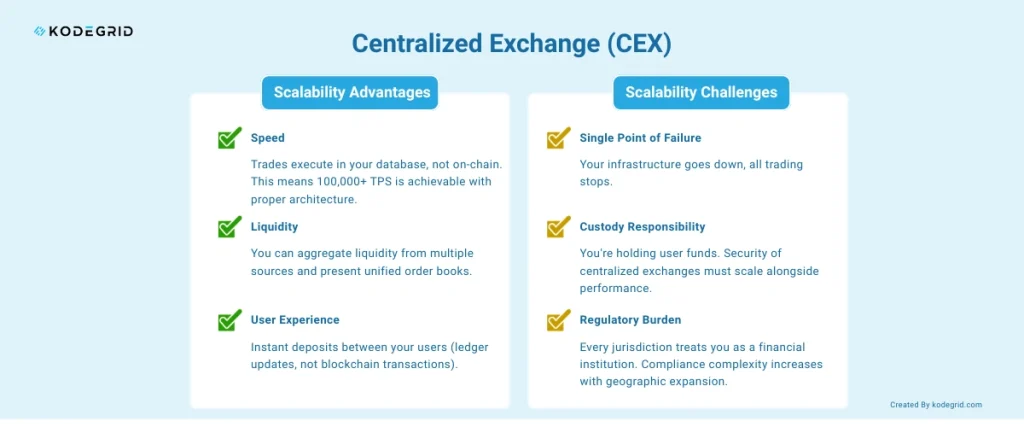
In a centralized exchange model, you control all private keys, your servers execute every trade, and your database maintains the complete order book.
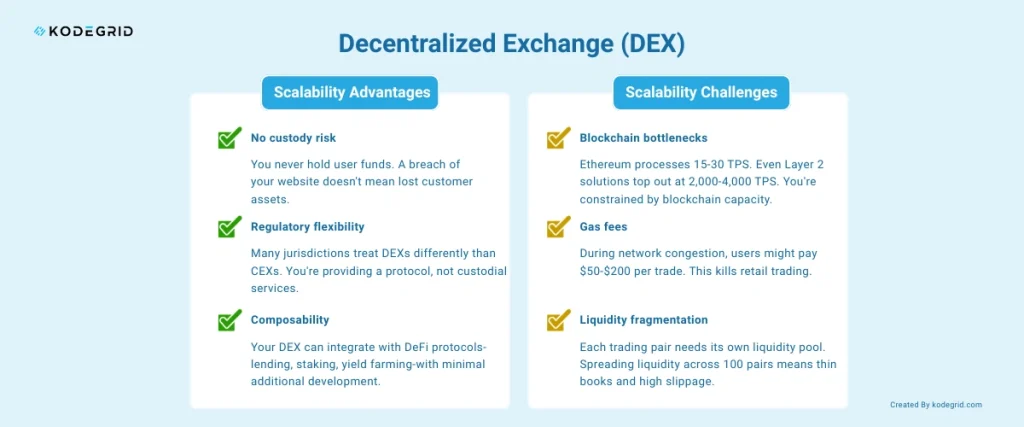
A decentralized exchange operates fundamentally differently from traditional platforms-smart contracts execute all trades autonomously, users retain complete control of their private keys, and the blockchain itself serves as your order book through on-chain order matching or automated market maker (AMM) liquidity pools.
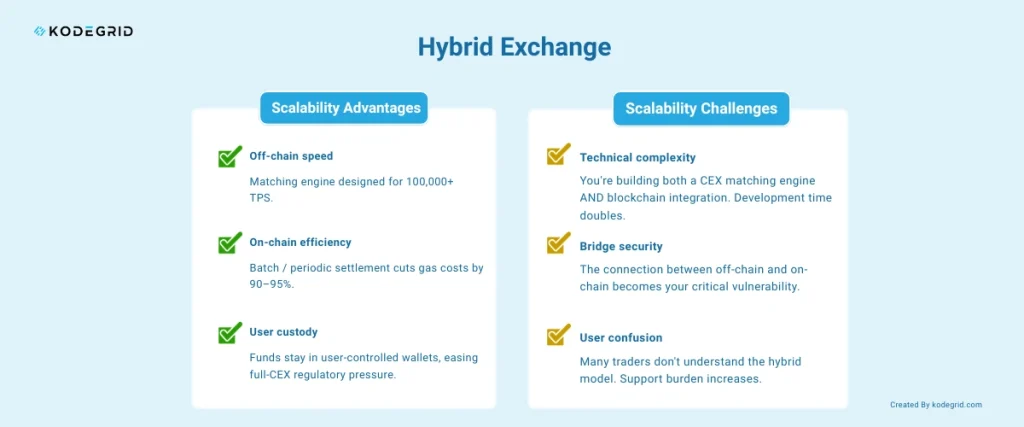
Hybrid exchanges combine CEX speed for trading with DEX security for custody. Users deposit funds to smart contracts rather than your custodial wallets, maintaining control of their assets.
This is where most exchanges fail. They start with a monolithic application-one big codebase that handles everything. This works fine for 100 users. At 10,000 users, it becomes unmaintainable. At 100,000 users, it collapses.
The crypto exchange architecture decision you make in month one determines whether you can scale in month twelve.
Your trading engine is the brain of your exchange. Every trade flows through here. Get this wrong, and nothing else matters.
The technical requirements:
Throughput capacity: 100,000+ transactions per second

Let me put this in perspective. During Bitcoin’s 2024 rally, Binance processed peaks of 500,000+ TPS. If your engine maxes at 10,000 TPS, you’ll crash during your biggest revenue opportunity.
But here’s the counterintuitive truth: most exchanges never reach 10,000 TPS. So why build for 100,000 TPS?
Because crypto trading isn’t evenly distributed. You might average 2,000 TPS over 24 hours. But during a 5-minute Bitcoin surge, you’ll hit 50,000 TPS. Your system must handle peaks, not averages.
Your database strategy determines whether you can scale from 1,000 to 100,000 users without a complete rebuild.
The problem most exchanges face:
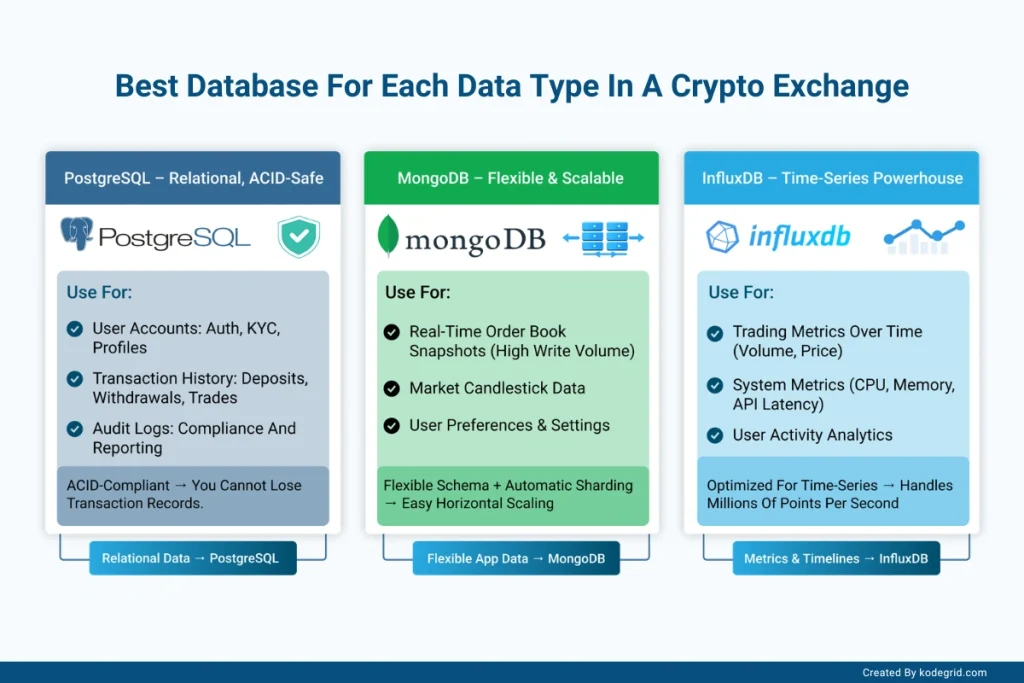
At 1,000 users, your PostgreSQL database on a single server works perfectly. Queries return in 10-50 milliseconds. You’re storing 10 GB of data.
At 100,000 users, you’re storing 2 TB of data. That same query now takes 3-5 seconds. Your database has become your bottleneck.
The solution: Database sharding
Database sharding is the solution when a single database becomes your bottleneck, because it splits your data horizontally across multiple servers instead of forcing one machine to handle everything.
In a range-based sharding setup, you don’t keep all 100,000 users in one database; instead, you might have Database 1 for user IDs 1–25,000, Database 2 for 25,001–50,000, Database 3 for 50,001–75,000, and Database 4 for 75,001–100,000.
That way, when User #30,000 places an order, your application routes the query only to Database 2, effectively cutting the query load on each database by about 75% and improving performance because each shard handles a smaller slice of data and traffic.
78% of exchange security breaches happen due to poor wallet architecture, not sophisticated hacks. The pattern: Exchange grows, hot wallet holds $10 million, hacker compromises one server, funds vanish.
Cold Wallets (95% of assets): Private keys never touch internet-connected computers. Distribute across 3 geographic locations (40%, 35%, 20%). Use 3-of-5 or 5-of-7 multi-signature-requiring 5 of 7 key holders to authorize any transaction. Key holders: CEO, CTO, CFO, Head of Security, plus 3 keys in bank vaults across different locations.
Why it works is because Hackers must compromise 5 separate people or locations simultaneously-exponentially harder than breaching one server.
Hot Wallets (5% of assets): Handle instant withdrawals but remain your biggest vulnerability.
The brutal reality of liquidity:
You can have the fastest matching engine in the world. Perfect security. Beautiful UI. But if your order books are thin, traders won’t use your exchange.
Why? Because of slippage.
On Exchange A (deep liquidity): User wants to buy $100,000 of ETH. Order fills at $3,500 per ETH. Total cost: $100,000.
On Exchange B (your thin order book): Same $100,000 order. First $20,000 fills at $3,500. Next $30,000 at $3,510. Next $30,000 at $3,525. Last $20,000 at $3,545. Total cost: $103,250.
The user paid $3,250 extra due to slippage. They never come back.
This is the liquidity crisis that kills 78% of failed exchanges: thin order books, wide spreads, and orders that simply never fill. To protect your platform, you need to actively manage liquidity every day-optimizing market maker incentives, monitoring depth and spreads in real time, and continuously boosting liquidity across your core trading pairs.
Here’s what keeps exchange founders up at night:
You’ve spent 12 months building the perfect exchange. Your technology is solid. Liquidity is deep. Users are signing up. Then you get the email from your bank: “We’re terminating your account due to regulatory concerns.”
Or worse: A regulator sends a cease-and-desist letter. Your exchange is operating illegally in jurisdiction X. You have 30 days to shut down or face $50,000 daily fines.
This scenario has killed more exchanges than hacks and technical failures combined.
The problem isn’t compliance itself-it’s that most exchanges hardcode compliance rules into their application logic. When regulations change (and they change constantly), you need developers to rewrite code. This takes weeks or months. By the time you’re compliant, regulations have changed again.
You’ve built the perfect exchange. Your code is clean. Your database is optimized. Then Bitcoin spikes 15% in 30 minutes.
10,000 users become 100,000 users in an hour. Your servers are at 95% CPU. Response times jump from 50ms to 3 seconds. Users can’t log in. Trades are delayed. Within 2 hours, you’re trending on Twitter for all the wrong reasons: “#YourExchange is down during the biggest Bitcoin move of the year.”
This is the scenario that separates amateur exchanges from professional ones..
The difference? Auto-scaling cloud infrastructure that expands capacity automatically before you even notice the traffic spike-and avoids the kind of scaling mistakes that crash most new exchanges during their first bull run.
Scaling a cryptocurrency exchange isn’t about user acquisition-it’s about infrastructure that handles 10x growth without breaking.
Most exchanges fail by prioritizing marketing over infrastructure. They attract 50,000 users, crash during the first Bitcoin rally, and those users never return.
Successful exchanges don’t scale through aggressive marketing. They scale through infrastructure that supports 10x growth, liquidity that prevents slippage, security that protects assets, and compliance that enables global expansion.